
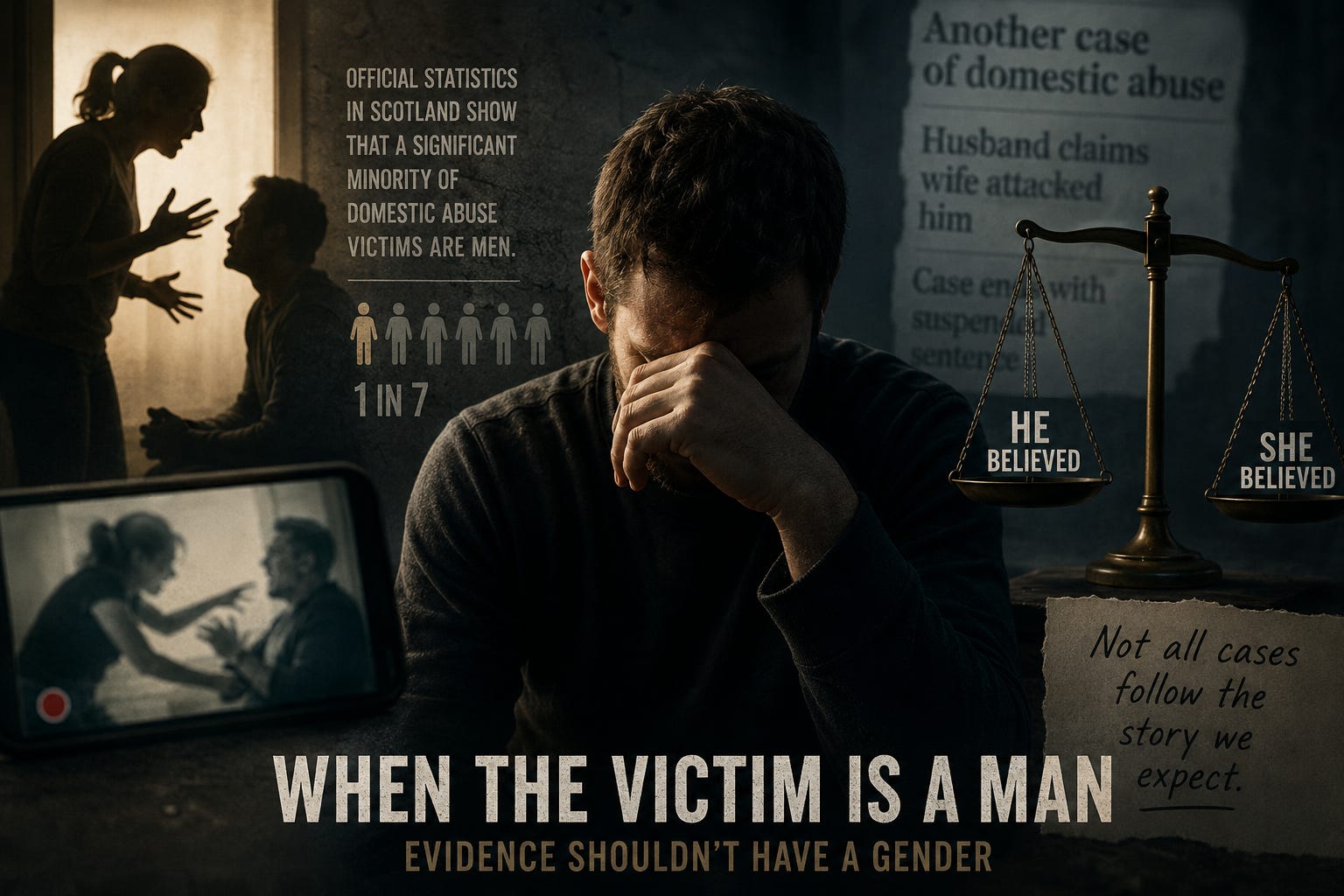
Domestic abuse is usually discussed through the lens of its most common pattern. Women are more often the victims. Men are more often the perpetrators.
That reality should never be ignored.
It is not, however, the whole picture.
Every year, thousands of men also report being victims of domestic abuse. Their experiences receive less public attention and often sit uneasily alongside the assumptions many of us instinctively make about violence within relationships.
One case from England illustrates why.
In October 2025, court proceedings involving property developer Adam Plumb and his former wife, Christina Schmid, attracted local media attention after video footage was shown capturing an incident inside their home. The recording showed Schmid shouting at her husband, scratching and biting him before deliberately injuring herself and accusing him of assault.
The court rejected that account.
The judge described Schmid as “the aggressor all along” and she was convicted of assault. She received a suspended prison sentence together with a restraining order.
The facts alone make the case unusual. Video evidence that captures an incident as it unfolds is relatively uncommon in domestic abuse cases, where courts are often required to assess competing accounts without independent recordings.
Yet despite those features, the case generated relatively little sustained national discussion.
That may be the more interesting question.
Over the past two decades, public understanding of domestic abuse has changed significantly. Campaigns have encouraged victims to come forward, challenged outdated assumptions and helped ensure that many offences are treated with the seriousness they deserve.
Those changes have mattered.
At the same time, public understanding has largely developed around the most common pattern. When people think about domestic abuse, they naturally picture a male offender and a female victim.
Most cases follow that pattern.
Not all of them do.
Official statistics in Scotland consistently show that a significant minority of domestic abuse victims are male. Behind those figures are real people reporting violence, intimidation and coercive behaviour within relationships. Their experiences exist regardless of how often they appear in headlines or public debate.
Many male victims describe another difficulty beyond the abuse itself.
Some hesitate before contacting the police because they fear they will not be believed. Others worry that they will instead be viewed as the primary aggressor.
According to reports presented during the Plumb case, previous attempts to seek help resulted in scrutiny of him rather than his wife. Whether or not that experience is representative of every case, it is one that many male victims say they recognise.
The case also raises broader questions about public attention.
Some criminal cases become part of a national conversation. Others remain largely confined to local reporting. There are many reasons why that happens and not every difference reflects bias. Editorial priorities, competing news stories and public interest all play their part.
Even so, it is difficult to ignore that cases involving female perpetrators and male victims often receive less sustained discussion than cases involving male perpetrators and female victims.
Whether that difference reflects editorial judgement, public expectations or something else entirely is a question worth asking.
The issue is no less relevant in Scotland.
The Domestic Abuse (Scotland) Act 2018 is deliberately gender neutral. The law applies regardless of whether the victim is male or female. In principle, the legal protections available to victims are the same.
Public perception is often more complicated.
Scottish Government research has found that many male victims remain reluctant to report abuse. Some fear embarrassment. Some fear disbelief. Others worry that they will be viewed as responsible for the situation rather than as the person seeking protection.
Those concerns deserve to be taken seriously.
Not because male victims are more important than female victims, but because justice should not depend on who is standing before the court.
Recognising male victims does nothing to diminish the experiences of women.
The two are not in competition.
If domestic abuse is wrong because of the harm it causes, then that principle should apply consistently regardless of the sex of either the victim or the offender.
The Plumb and Schmid case does not prove that every male victim will encounter disbelief, nor does it demonstrate that the justice system treats men unfairly as a matter of course.
It does demonstrate that cases exist which challenge many of our assumptions about domestic abuse, victimhood and public reaction.
Those cases deserve to be discussed for the same reason any other criminal case deserves attention.
Not because they reinforce an existing narrative.
Because they happened.
Justice is strongest when it applies the same principles regardless of who stands before the court.
That means recognising uncomfortable cases as readily as familiar ones.
The victim should never have to fit an expected pattern before being taken seriously.
Editor’s note: This article is a revised and expanded edition of a piece first published on accused.scot in October 2025. It has been updated for publication on Substack to reflect the publication’s current editorial style while preserving the substance of the original argument.